Two hours working on a car can create four hours of work for a mobile detailer. Preparation, travel, site setup and the customer handover still use your time. If you price only the visible cleaning, a busy day can produce a very different result from the one you expected.
This tutorial follows fictional solo detailer Jordan quoting ordinary maintenance work on one compact car. Every duration, dollar amount and percentage is illustrative, expressed in USD, and chosen to make the arithmetic easy to inspect. None is a market rate, recommended wage or promised result. The calculation supports a business decision; it is not an accounting-profit statement.
1. Cost a defined job rather than a package name
Start with the vehicle, condition information, included work and confirmed site. Jordan's estimate covers one compact car, accessible agreed areas and ordinary maintenance work within Jordan's existing capability. Paint correction, coatings, specialist remediation and unagreed additions remain outside it. The same label on a price list can conceal very different work, so keep the scope beside the numbers.
Record assumptions that affect effort: travel route, parking, equipment access, utility arrangements and the confirmed wash-water plan. If an essential condition is unknown, resolve it before treating the estimate as ready for a firm quote. A cost spreadsheet cannot make an unsuitable location workable.
Business Queensland's pricing guidance distinguishes hourly service pricing from a project price based on scope, and includes business costs and available time in pricing decisions. That supports checking the whole job. It does not supply a detailing rate or decide what a customer in your market will accept.
2. Convert the entire workload into hours
Jordan uses seven non-overlapping blocks. Record round-trip travel once, rather than counting the outward drive and forgetting the return. Keep preparation distinct from setup at the customer's site. Include the time needed to pack equipment away and complete the agreed handover and job administration.
- Intake and quote: 15 minutes; preparation: 20 minutes.
- Round-trip travel: 40 minutes; site setup: 15 minutes.
- Agreed service: 120 minutes; pack-down: 15 minutes.
- Handover and administration: 15 minutes.
3. Value owner time and add costs without double counting
The seven blocks total 240 minutes, or four hours. Jordan uses a fictional owner-labor valuation of $30 per hour, giving 4 × $30 = $120. This is a chosen planning value for the owner's time. It is not necessarily a wage payment, a customer-facing hourly rate or a tax-deductible expense.
Add $18 for supplies used, $12 for vehicle costs allocated to this job and $20 for equipment and other overhead. The modeled job cost is $120 + $18 + $12 + $20 = $170. Define what each category includes so the same fuel, equipment wear or recurring expense does not appear in two places.
A supply purchase and supply consumption are different records. Buying a large container for future jobs does not mean its whole purchase price belongs to this one car. Likewise, an overhead allocation is a planning share of wider business costs, not proof that a bill of exactly $20 arrived during this visit. Keep the evidence and allocation method behind each estimate.
Travel has both time and vehicle-cost effects here. The $12 vehicle figure does not replace the 40 minutes of owner time. If your own vehicle-cost method already includes an item in overhead, adjust the categories before adding them together.
4. Separate the allowance, target margin and markup
Jordan adds a $10 planning allowance to the $170 cost estimate, producing a pricing base of $180. Keep the allowance visible: it represents uncertainty in the estimate, not a new purchase or an expense that has already occurred. A reserve is not a substitute for resolving a known site problem.
For a target modeled margin of 20% of the quoted service price, with payment fees set to zero, divide the pricing base by the part of the price left after that margin: $180 ÷ (1 − 0.20) = $225. Checking backward, $225 − $180 = $45, and $45 ÷ $225 = 20%.
A 20% markup uses a different denominator: $180 × 1.20 = $216. The $36 difference above that pricing base is 16.67% of $216, not 20%. Business Victoria's explanation distinguishes margin measured against sales from markup measured against costs. This example borrows that denominator distinction; it does not label Jordan's chosen owner-time model as accounting gross or net profit.
The $225 figure is before separately determined tax. It assumes zero payment fees only to isolate the example. Actual fees, tax treatment, discounts and charges must be established separately. Do not paste this figure into a live quote without replacing the assumptions with those of your own job.
5. Test the uncertain inputs before treating the result as a quote
Ask which input is least reliable. Jordan has allowed 120 minutes for service, but condition photos may leave part of the interior unclear. Resolve the condition question or identify a clear inspection hold point. Adding arbitrary percentages to every line can make the number larger without making the scope more understandable.
Try one sensitivity check: if the same service took 30 extra minutes, the modeled owner-time cost at $30 per hour would rise by $15. That already exceeds the $10 allowance. This does not predict an overrun; it shows that a small reserve cannot cover every possible change. Do not add this sensitivity scenario to the original estimate as though it happened.
A technically correct calculation may still describe an offer you do not want to make. You can adjust the scope, improve reliable assumptions or decline the job. If the customer needs a lower price, discuss what changes in the service instead of silently removing the value assigned to your time.
6. Save the estimate so the completed job can teach you something
Save the original assumptions and a dated quote version before starting. Record what the customer accepted and the process for discussing changes. Your internal model can have seven time blocks and several allocation notes while the customer receives a concise description of the service and agreed price.
After the job, enter actual time and costs in a separate comparison. Do not overwrite the plan to make the estimate appear accurate. An overrun is information for review; it does not automatically alter an agreed customer price. The review article follows Jordan's actual 285-minute outcome and explains the different residual it produces.
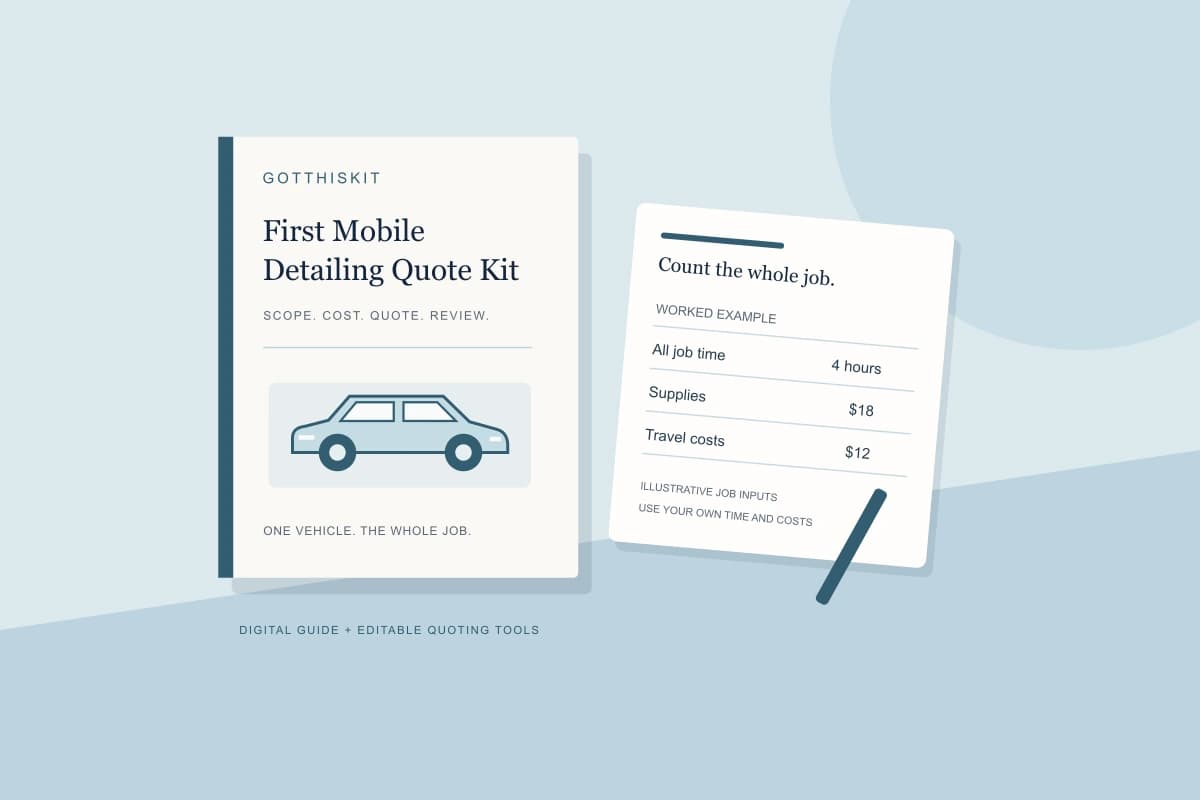
Explore the First Mobile Detailing Quote Kit for further quoting and review structure. Start with the site checklist if the scope is still uncertain, then bring only confirmed assumptions into your own calculation.
Build the cost from the whole workload, keep allocations and allowances visible, and check which denominator your percentage uses. Save the original model before comparing it with the finished job.