A customer asks what you charge to detail a compact car at their home. The vehicle size is a start, but it does not describe the condition, the requested result or the place where you will work. A price sent before those questions are answered can leave you committed to a job you cannot deliver as described.
Follow fictional solo detailer Jordan, preparing a quote for ordinary maintenance cleaning of one compact car. The purpose is to decide whether this specific job fits Jordan's existing skills and setup, then describe it clearly. This is business preparation, not training in cleaning methods, paint correction, coatings or remediation.
1. Identify the car and the customer's actual priority
Ask for the vehicle type, approximate size and the areas the customer wants addressed. A compact hatchback with a loaded luggage area presents a different working scope from an empty one. Ask whether the request is a routine refresh or an attempt to resolve a particular stain, odor or surface defect. Do not translate every request into your standard package without discussion.
For Jordan, the customer wants routine interior cleaning and an exterior maintenance wash. The first draft describes the included accessible areas and says that personal belongings will be removed by the customer. It excludes paint correction, coatings, engine work, disassembly and specialist contamination treatment. These are boundaries of this fictional offer, not an industry-wide definition of detailing.
Ask which result matters most, then describe what you can reasonably undertake. A request to make the car look new is too broad to quote against. Record visible condition and known limitations without promising that every mark will disappear. If you cannot assess a concern within your competence, leave that concern outside the quote.
2. Use condition information to resolve questions, not hide them
Recent photos can help you ask better questions, but a camera angle cannot establish every surface condition. Request only views relevant to the proposed work. Explain that unresolved condition questions need inspection before a firm scope is confirmed. Label the record with when it was supplied so an old photo is not mistaken for today's condition.
Jordan records 'rear seats and luggage area not yet shown' instead of assuming those areas match the front seats. If the customer reports an unfamiliar residue or a problem outside ordinary maintenance, Jordan pauses that part of the request. More time is not always the answer to work outside your competence.
Keep customer details, registration information and private possessions out of shared examples. Permission to receive photos for a quote does not imply permission to publish them. Store useful condition notes in the job record, avoid unnecessary personal detail and confirm the current condition together on arrival before starting.
3. Confirm access, working space and the utilities you actually need
Establish the exact working location rather than recording only a street address. Ask who can authorize its use, where your vehicle can park and whether you can reach the agreed work area. Shared parking, managed property and a customer's private driveway may have different permission arrangements. A customer's preference does not answer a property manager's access question.
Check the route for equipment and the space needed around the car. Record obstacles, shared pedestrian access and any time restrictions that affect the plan. Agree who will move the customer's vehicle if movement is needed. Do not quietly include driving it or holding its keys without a specific arrangement.
If your setup depends on site water or power, confirm availability and permission to use it. Verify suitability against the manuals for your actual equipment; a photo of a tap or outlet is not a technical check. If you bring your own supplies, confirm that the site still suits that setup. Leave unresolved requirements visibly open rather than writing 'utilities available' by default.
4. Treat wash-water arrangements as a condition of the job
The US EPA's vehicle-washing fact sheet explains that wash water can carry detergents and pollutants from vehicles into storm drains. It is municipal education guidance, including advice aimed at residents; it is not permission for a mobile business to use any particular drainage route. Use it to understand why the location matters, then check requirements for the actual place of work.
Portland's Environmental Services page provides a concrete local example: its mobile-washing guidance addresses collection of wash water and asks customers to confirm a city Discharge Authorization. That is Portland-specific information. It does not establish the requirements in your city or authorize discharge into a convenient drain elsewhere.
Jordan therefore records the planned working area, how wash water will be managed and which local authority or site operator must confirm the arrangement. A customer's statement that previous cleaners used the driveway does not resolve the question. If the required arrangement cannot be confirmed and delivered with Jordan's setup, the wet exterior work stays on hold while an appropriate alternative is assessed.
5. Connect the scope to a realistic visit plan
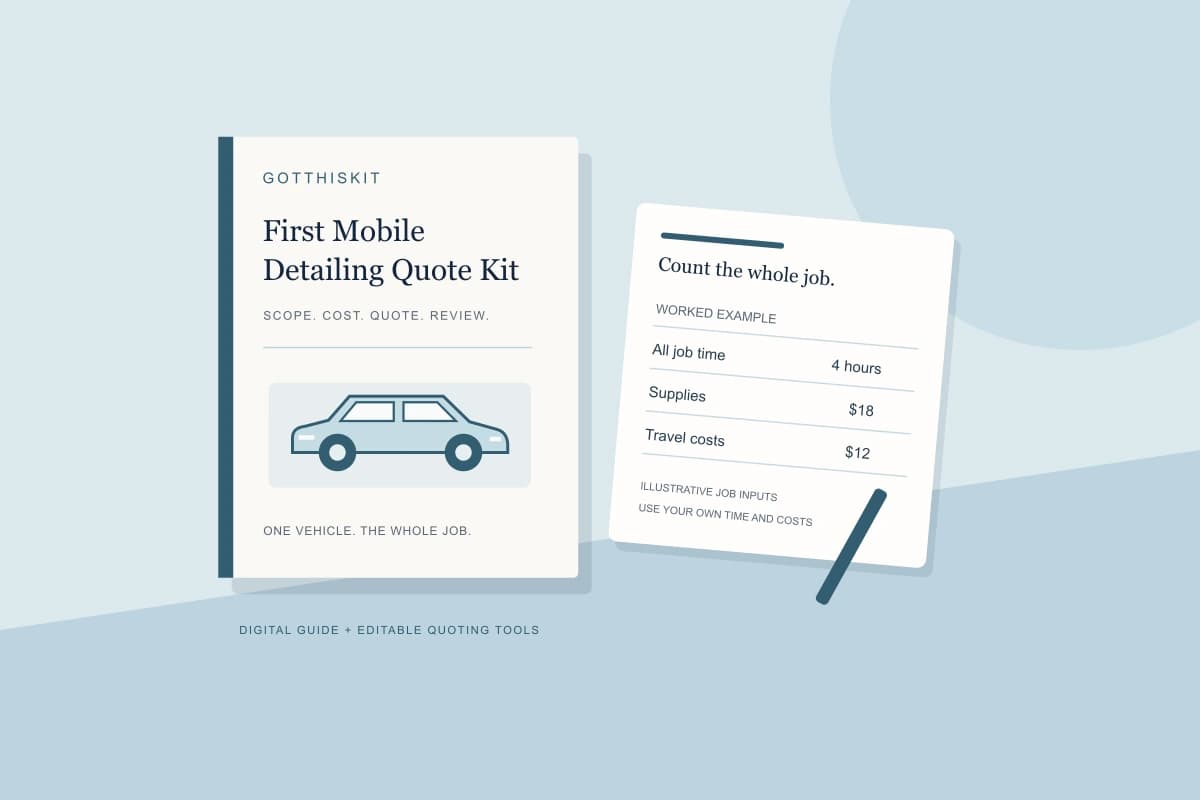
Separate the customer's appointment window from all the work the job creates. Jordan's fictional plan includes intake and quoting, preparation, round-trip travel, setup, service, pack-down and handover administration. Only part of that time is spent actively cleaning the car. The cost article works through the full 240-minute plan.
Confirm when the customer needs the vehicle back and when someone will be available for the initial check and handover. Include the work required to leave the agreed area ready for normal use. Do not fill the entire appointment with service time and hope that setup and pack-down happen outside the clock.
State what happens if weather or site conditions make the planned work unsuitable. The answer may be to reschedule, choose another appropriate site or discuss a smaller service. Those choices must be agreed; they are not automatic substitutions. A conditional quote should name the condition and the point when it must be resolved.
6. Send a quote the customer can check against the car and site
Bring the confirmed information into a short customer-facing description: vehicle, included work, exclusions, location assumptions, timing, price and applicable payment arrangements. Explain the tax treatment separately for your actual business and location. Keep internal labor valuations and costing assumptions in your own model unless they are needed to explain the offer.
Describe the change process before the visit. If inspection reveals something materially different, pause, explain the available choices and agree any revised scope or price before extra work. An unexpected delay or a personal estimating mistake does not automatically create a surcharge.
Finish with a decision: ready to quote, awaiting named information or outside your offer. Explore the First Mobile Detailing Quote Kit for further structure. Its companion articles show how to turn a confirmed scope into a cost model and how to learn from the completed job without rewriting the original agreement.
Before sending a firm figure, confirm one vehicle, one service scope and one workable site. An unanswered access, utility or wash-water question belongs on a hold list, not inside an assumption.