You can leave a card show with a thicker cash envelope and still be unsure whether the day covered its costs. Some of that cash may be your opening float. Some replaces money you previously spent on cards. Card payments may reach your bank later and arrive with fees deducted.
Use a short review that connects each total to its records. The USD amounts below are fictional examples, not card valuations, recommended margins or earnings forecasts. The result measures a stated set of event costs before owner time, ongoing overhead and tax; it is not a complete accounting profit figure.
1. Start with the items sold and amounts agreed
For each completed sale, bring together the transaction reference, stock IDs, quantities, item amounts and payment method. Check that a bundle's item amounts add to the total the buyer paid. Preserve any refund or adjustment beside its original transaction so you can understand the final amount without reconstructing conversations from memory.
Separate completed sales from offers, temporary holds and requests to contact someone later. A visitor saying they may return is not revenue. Nor is the asking-price total on the cards still in your case. Those cards remain inventory, and their future selling price is uncertain until a sale actually happens.
Keep the record private. Use item and transaction references for the business review; avoid collecting extra personal information simply to make the worksheet look complete. Store any customer details required by your normal selling process in the appropriate business system rather than a publicly visible table log.
2. Reconcile cash and card payments separately
Suppose you started with an $80 cash float, received $150 in cash sales and paid $20 of event expenses from the cash box. With no other cash movements, the expected closing cash is $210: $80 plus $150 minus $20. The sales figure is $150, not $210. Keep the expense receipt and explain any difference from the actual count.
In this fictional day, another $270 of sales was paid by card, giving $420 of gross item sales altogether. If $12 of payment fees applies, the corresponding card proceeds would be $258 before other adjustments. Match actual transactions and fees to your provider's report; do not change recorded selling prices just to match a bank deposit.
For stock sold through eBay, its reconciliation guidance distinguishes order, fee and payout information and provides reports to compare with your own records. Those reports cover eBay activity, not cash taken at your show table. Keep sales channels identifiable so a payout or imported report does not make you count the same sale twice.
3. Match costs to the stock that actually sold
Bring the recorded acquisition cost of the sold items into the review. Do not subtract the purchase cost of every card you brought while ignoring the stock you took home. Equally, cards bought long before the event are not free merely because their purchase did not appear on this week's bank statement.
For the worked example, the cards sold for $420 have a recorded total cost of $210. Payment fees are $12 and the defined event expenses total $100. The result is $98: $420 minus $210 minus $12 minus $100. The earlier $20 cash expense is already part of that $100, so it must not be subtracted again.
Label the result accurately: estimated trading result before owner time, ongoing overhead and tax. If an item's cost is missing, mark that gap and resolve it rather than inserting zero. For cards bought as part of a larger collection, use a consistent, supportable allocation in your business records; this example does not determine your accounting or tax treatment.
4. Keep new purchases and trades visible
Buying additional cards at the show uses cash and changes inventory. Suppose you also spend $120 on stock that remains unsold at closing. Record the payment and the new items separately. It reduces available cash now, but it is not another $120 of acquisition cost for the different cards already included in the worked sales calculation.
A trade also needs its own record. Note the items leaving, the items received, any cash exchanged and the values recorded under your established accounting approach. Do not present a trade's headline value as cash sales. If trades make your review difficult to interpret, summarize them separately before combining anything into broader business accounts.
Check the physical stock against the movement record. Opening quantity, sales, returns and new acquisitions should explain what is left. A missing item is a discrepancy to investigate; it is not evidence of a sale without a corresponding transaction. The inventory tutorial gives you a simple way to keep those references connected.
5. Compare the day with the purpose you set
List the whole time commitment: stock preparation, pricing, travel, setup, selling, packing and administration afterward. A $98 estimated trading result has a different meaning when the trip required many additional hours. Record those hours even if you have not yet chosen a value for your own time. They help you compare future options on the same basis.
Review useful observations separately from money. Which categories generated specific requests? Which labels caused confusion? How much time did it take to locate items or record bundles? Count only what your records support. A new follower or friendly conversation may be encouraging, but it is not a completed sale or proof of future demand.
6. Give the next show a clear condition
Choose return, change or wait, and explain the condition behind it. You might return if travel costs stay within your limit, simplify the display because setup took too long, or pause until you can resolve inventory gaps. Avoid turning one busy or quiet event into a prediction about every future show.
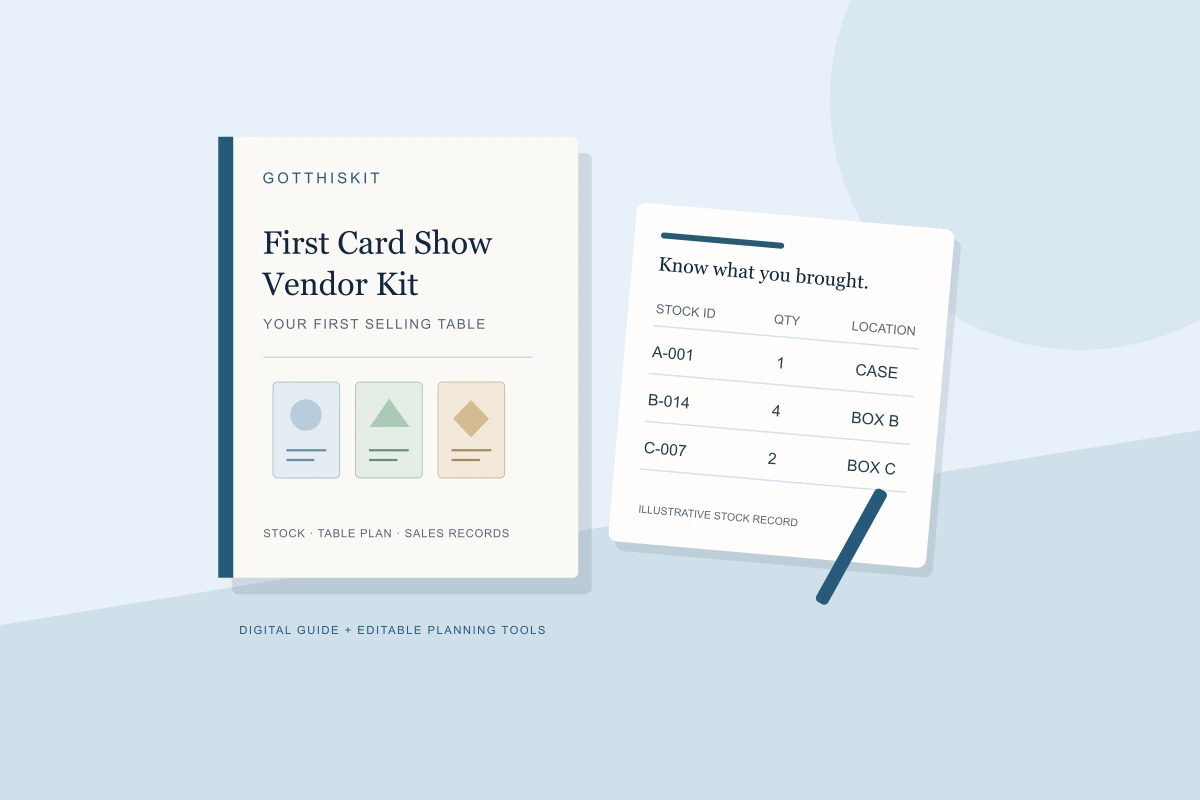
Keep one small improvement attached to the evidence: 'use the same transaction reference on all bundle items' is more actionable than 'be more organized.' Use the first-vendor checklist before another commitment, and explore the First Card Show Vendor Kit page for its current scope and availability.
Reconcile one sale from stock ID to payment, then calculate the event result using sold-stock costs and actual expenses. Keep the cash balance and the result clearly labeled.