An organizing visit can look finished while leaving the client unsure what to do next. A labeled box may contain decisions nobody has made. A bag marked for donation may still need an approved destination. A tidy surface may work only while you are there to explain it. Finishing means making those differences visible.
Use the fictional example of Morgan's entryway drop zone: one shelf, an existing tray, a bag place and papers awaiting a decision. The agreed goal is a usable arrival routine. This article shows how to close that small project honestly, without claiming the whole home is organized or turning every unresolved item into another appointment.
1. Evaluate the agreed outcome, not an imaginary perfect room
Before packing up, return to the words agreed at intake. Can Morgan put down the bag, find the keys and identify where papers go for a later decision? Check those actions in the actual space. The amount removed and the attractiveness of the labels are observations, but neither proves that the chosen routine works.
Ask Morgan to demonstrate the routine and describe anything that feels awkward. If the tray is inconvenient, change its position within the agreed area. If Morgan prefers no label on a familiar place, discuss that preference rather than treating the label as the deliverable. Record what the client wants to try, not a judgment about whether their taste matches yours.
The NAPO Greater Philadelphia Chapter describes organizing as creating systems around the client's needs and helping clients make their own decisions. Its FAQ is a chapter resource, not a certification of this method. The practical implication here is to test usefulness with Morgan rather than declare success on Morgan's behalf.
2. Separate working arrangements from unresolved decisions
Make a brief closing record with three groups: working now, awaiting a decision and outside this visit. For Morgan, the key tray and bag place may be ready to use. The papers in the pending folder still need Morgan's review. The closed cupboard was never part of the agreed task. Giving these different statuses prevents a small successful session from becoming a misleading whole-room claim.
For each unresolved item, record its location, who can decide and the next agreed action. For example: 'Envelopes remain unopened in the pending folder; Morgan will review them at a time Morgan chooses.' If no review date has been chosen, say so. An invented deadline does not resolve the uncertainty.
Keep notes factual and limited. 'Owner not present; item retained on shelf' gives the next person useful information. A speculative explanation of why someone has kept it does not. Never make automatic disposal the consequence of missing a review date or failing to respond to a message.
3. Do not confuse a donation label with a completed handover
An item selected for donation has not yet been donated. Confirm the client's decision about the specific items, where they will remain and who is responsible for the next step. If transport or disposal is outside your agreed service, record that limit. Do not put the bag in your car simply because you want to leave a completely clear photograph.
APDO's article by member Sheena Taylor recommends allowing time to research practical disposal options and notes that recycling arrangements vary by location. That supports checking a real destination; it does not establish that a particular organization accepts Morgan's items or that you are authorized to transport them.
If an agreed next step depends on a donation service, verify its current acceptance and handover arrangements through that service's own information. Keep uncertain items in the client's agreed location. You can finish the organizing visit with a clearly assigned next action while being honest that the donation itself remains incomplete.
4. Leave a routine the client can explain back
Keep the handover short enough to remember. For this project: keys use the agreed tray, the everyday bag has its agreed place, and papers needing a decision go into the identified folder. Ask Morgan to explain it in their own words. If the explanation needs a long set of exceptions, simplify the trial arrangement together.
Also explain what the pending folder does not do. It holds papers awaiting a decision; it does not process them, create permission to read them or guarantee that they will be reviewed. Morgan chooses an appropriate review routine. Avoid presenting a timer, label or container as a solution to every reason a task might remain difficult.
Use a private written summary if helpful and agreed. Photos are optional, and permission for a private record does not imply permission for marketing. APDO's member code includes client confidentiality and honest representation of expertise. Referencing that code does not make the project a member-approved service or authorize sharing a client's story.
5. Agree a bounded follow-up instead of an open-ended obligation
Discuss whether a follow-up would be useful, how it would happen and what it includes. Morgan might want one agreed check-in about whether the bag place works after several normal arrivals. Ask for the preferred channel and timing. Do not automatically add the client to marketing messages or treat a lack of response as a request for another visit.
Give the check-in a question you can actually answer: 'Which part of the arrival routine was awkward to use?' Distinguish clarification of the existing arrangement from a request to organize the cupboard. If further work is wanted, define a new scope and agree the time and any charges before treating it as scheduled.
Offer a real option to stop. The client may prefer to try the system independently, change it or leave the remaining decisions for later. A project can end with an honest list of limitations. You do not need to create a continuing service to make the first visit worthwhile.
6. Close the business record as carefully as the shelf
Record the agreed result, unresolved actions, actual time and any approved changes while the details are fresh. Separate what happened from what you estimated. In the companion timing example, a 180-minute plan became 190 minutes with an agreed extension. Preparation, travel and follow-up were recorded separately. None of that turns unapproved work into an automatic charge.
Ask what you would change in the next plan: a smaller sorting batch, an earlier checkpoint or clearer ownership questions. If the task ended outside your competence, document the practical boundary and the agreed next step without diagnosing the client. Store private records appropriately and share only what is needed with the people the client has authorized.
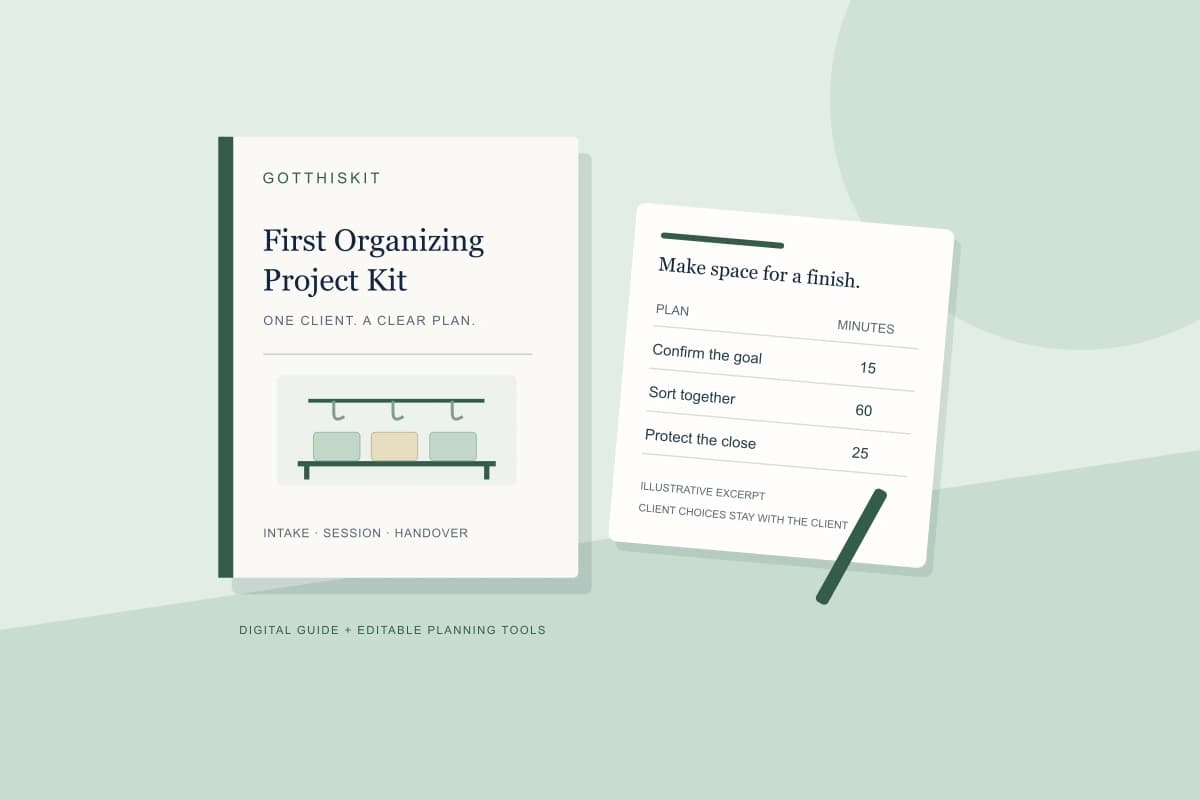
For a repeatable structure, explore the First Professional Organizing Project Kit. The intake and session-planning articles complete the sequence: define one outcome, protect time to finish, then leave the client with a routine and an accurate account of what remains.
Finish by testing the agreed routine, naming unresolved decisions and assigning only the next actions the client accepts. A clear ending can leave room for future choices without promising more work.