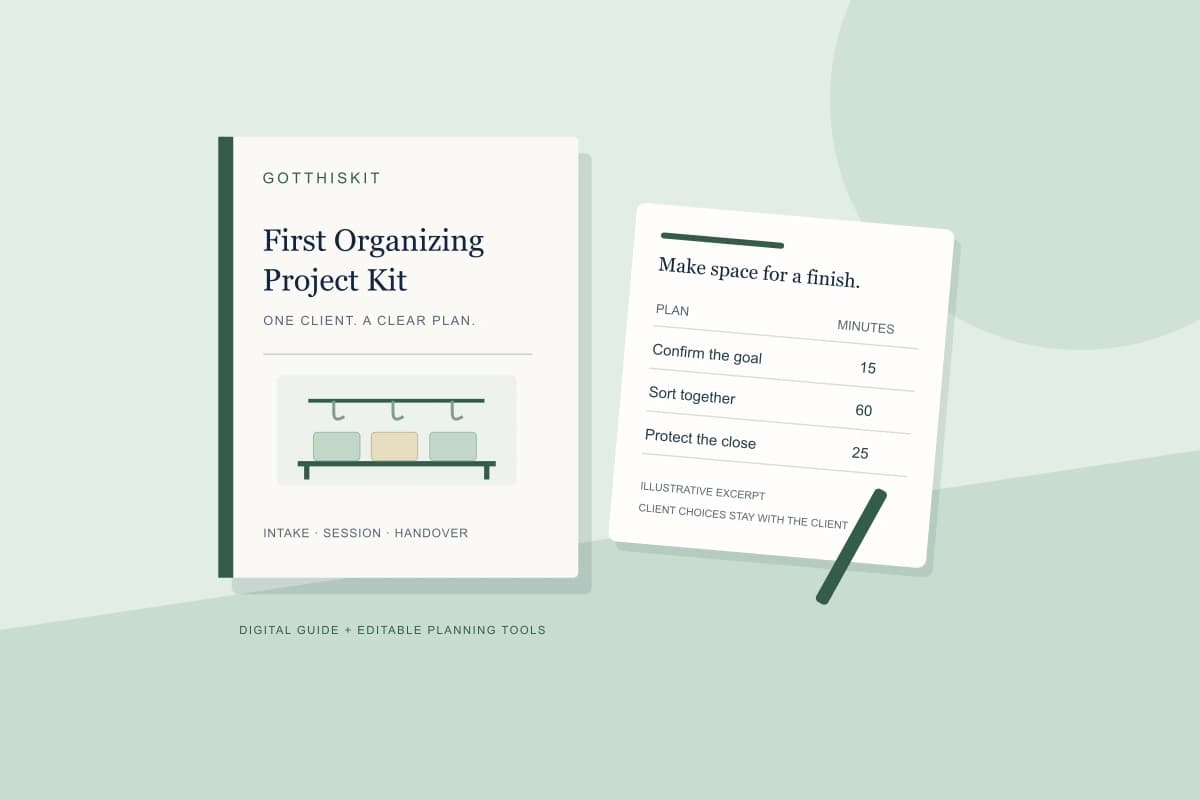
A three-hour appointment is not three hours of uninterrupted sorting. You need to confirm the task, make room for questions and breaks, test the arrangement and leave the client with a usable space. If the plan counts only the visible work, closing becomes whatever you can squeeze in after the appointment should have ended.
This tutorial uses fictional client Morgan and one entryway shelf or drop zone. The goal is a workable place for a bag, keys and papers awaiting a decision, using existing supplies. The example is an adjustable planning exercise, not a typical completion rate or a promise about what any client should achieve.
1. Choose a result you can test in the agreed area
Begin with the intake decision. Morgan wants to come home, put down everyday items and find them again. The working area is the shelf and agreed bag place, not the entire entrance or the cupboard beside it. Write the finish test before dividing the time: Morgan can demonstrate where each everyday item goes and knows which questions remain open.
NAPO's hiring guide asks professionals to explain their process, what a session looks like and what fees include. Use your plan to make those answers concrete. This example's time blocks are original illustrative choices, not a schedule supplied or endorsed by NAPO.
Check the available surfaces and materials with Morgan. An existing tray and a clearly identified pending folder may be enough to trial the routine. An uncertain shelf measurement or an attractive storage product should not turn into an unapproved shopping task during the visit.
2. Reserve the finish, then place the other blocks
For a 09:30 start and 12:30 finish, the full appointment is 180 minutes. Reserve the last 25 minutes for handover and resetting the area. Closing therefore begins at 12:05. Put that time in the plan before assigning sorting work, so it remains visible when the session becomes busy.
Here is one complete plan. Its six blocks add to 180 minutes. The active sorting, assigning homes and labeling total 120 minutes; the other 60 minutes already belong to confirmation, flexibility and closing. Do not count those minutes a second time as spare capacity.
- 09:30–09:45: 15 minutes to confirm the goal, permissions and working area.
- 09:45–10:45: 60 minutes to sort manageable batches with Morgan.
- 10:45–11:05: 20 minutes for planned flexibility and a break as needed.
- 11:05–11:45: 40 minutes to assign and test homes for the agreed items.
- 11:45–12:05: 20 minutes to label and rehearse the routine together.
- 12:05–12:30: 25 minutes for handover, unresolved items and restoring the area.
3. Work in batches you can put down safely
Choose a small group whose contents you can keep track of: the loose items beside the tray, for example. Confirm that you may handle them, then let Morgan decide what stays, what belongs elsewhere and what needs more thought. Leave private papers unopened unless a specific different task and permission have been agreed.
Avoid emptying every container simply because it creates a dramatic starting point. Before opening the next batch, ask whether you can finish or return it to an agreed temporary place within the available time. Keep the way through the entrance usable and avoid spreading possessions into unrelated rooms.
A temporary pending group is a record of an unresolved decision. It is not permission to dispose of its contents later. Give it a clear location and an understandable label. If Morgan cannot decide about a housemate's object, preserve it for that person's input instead of converting a lack of response into agreement.
4. Use checkpoints to reduce scope before time runs out
Check progress when a block ends. At 10:45, ask whether the remaining items prevent you from testing the main routine. If not, stop sorting and move to assigning homes. If a key decision remains unresolved, choose a smaller workable result with Morgan. The point is to make the change visible while there are still options.
The NAPO Greater Philadelphia Chapter's client FAQ explains that project duration varies and that organizing involves partnership and decisions. It provides context for discussing uncertainty; it does not prescribe this three-hour plan or justify blaming a client when your estimate needs revision.
Treat the break portion of the flexible block as real time, not a resource you can always reclaim. If the finish time is firm, shorten active work and preserve the reset. An extra cupboard becomes a later possibility. Any extension needs a fresh agreement before the extra time, including what it means for your stated fees; silence is not approval.
5. Rehearse the routine and protect the handover
Ask Morgan to try arriving with the usual bag and keys. Can the tray be reached comfortably? Does the bag place interfere with the route through the entrance? Can Morgan identify the pending folder without your explanation? Adjust the trial arrangement before adding labels that make it look permanent.
At 12:05 in the plan, switch to closing rather than starting another sorting batch. Return loose items to agreed places, identify anything that still needs a decision and explain the next small action. If Morgan changes a preference during the demonstration, record the adjustment; the purpose is a system the client understands, not a layout you can defend.
A clear handover can acknowledge a limited result. 'The everyday arrival routine is ready to try; these papers await your decision' is more useful than claiming the whole entryway is finished when a pile has only moved out of view.
6. Record actual time, including the work around the visit
Suppose the actual blocks were 20, 70, 15, 35, 20 and 30 minutes. They total 190 minutes, ten more than planned. In this fictional outcome, Morgan agreed to the extension before the extra time, so the visit ended at 12:40. With a hard 12:30 stop, you would instead need to reduce active work and close within the original window.
Also record 35 minutes of preparation, 40 minutes of total travel and 15 minutes of follow-up. Those add 90 minutes, bringing total project effort to 280 minutes, or four hours and forty minutes. This is a workload record, not an automatic bill: apply only the fees and charging arrangements you actually agreed.
Compare where the estimate changed before planning another visit. Explore the First Professional Organizing Project Kit for further structure, and use the intake and finishing articles to keep the boundaries consistent from the first conversation to the handover.
Put the closing block on the clock first. Work in small batches, review the scope at checkpoints and record the full effort afterward so the next plan starts from evidence.